
mainstage series
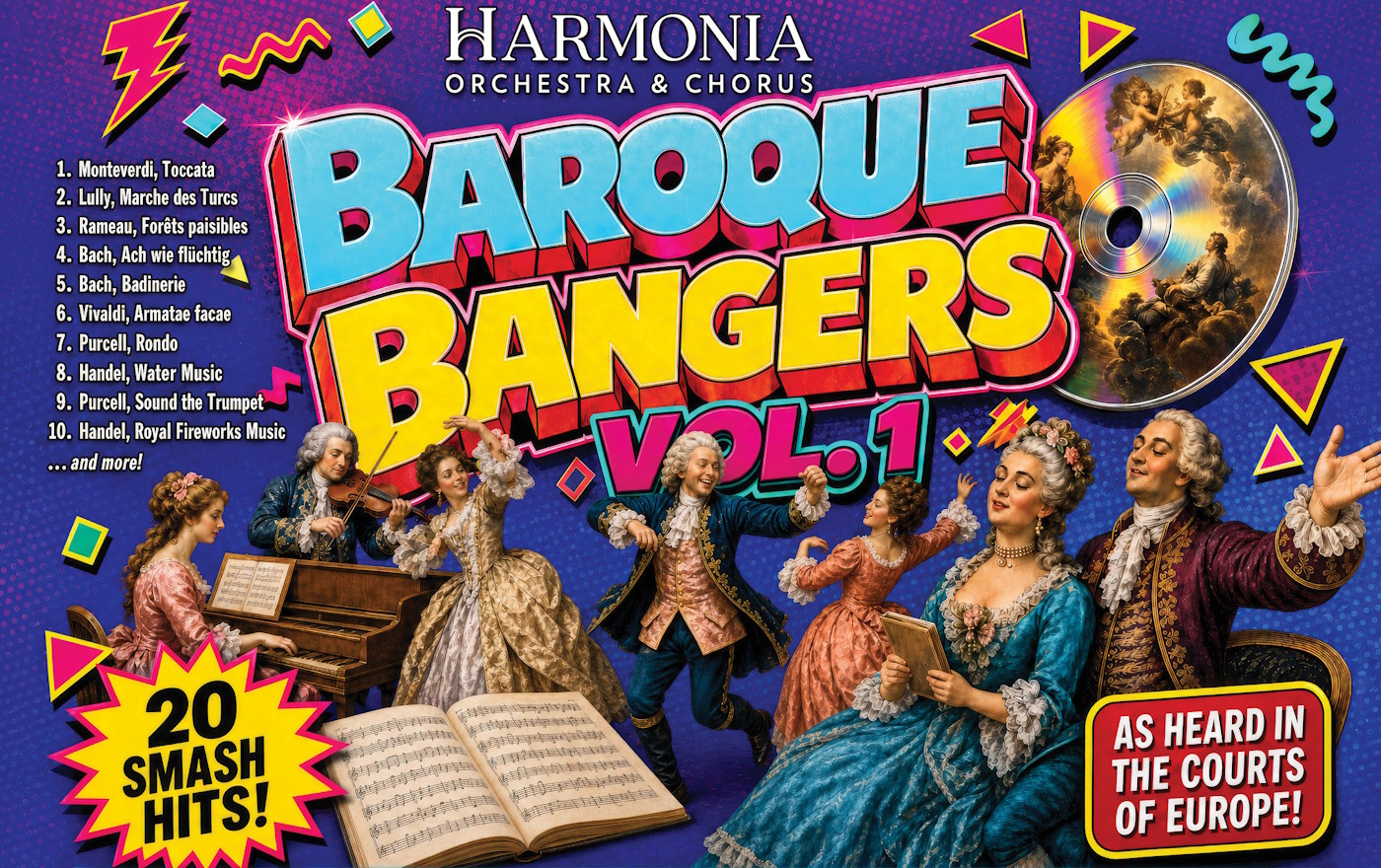
Saturday, October 3, 2026 • 7:30 p.m.
First Free Methodist Church (3200 3rd Ave W, Seattle)
Harmonia Orchestra & Chorus
William White, conductor
Natalie Ingrisano, soprano
Seattle Early Dance
Anna Mansbridge, choreographer
Program
Claudio Monteverdi (1567–1643)
Toccata from L’Orfeo
Jean-Baptiste Lully (1632–1687)
Marche pour la Cérémonie des Turcs from Le bourgeois gentilhomme, LWV 43
Jean-Philippe Rameau (1683–1764)
“Forêts paisibles” from Les Indes galantes, RCT 44
Johann Sebastian Bach (1685–1750)
Badinerie from Orchestral Suite No. 2 in B minor, BWV 1067
“Ach wie flüchtig, ach wie nichtig” from BWV 26
George Frideric Handel (1685–1759)
Allegro from Concerto Grosso in B minor, Op. 6, No. 12
Johann Sebastian Bach
“Jauchzet, frohlocket!” from Christmas Oratorio, BWV 248
Claudio Monteverdi
“Vanne, Orfeo, felice e pieno” from L’Orfeo
Henry Purcell (1659–1695)
“Now Joyn your Warbling Voices” from The Fairy Queen, Z. 629
George Frideric Handel
“Now Strike the Golden Lyre again” from Alexander’s Feast, HWV 75
Henry Purcell
March from Funeral Music for Queen Mary, Z. 860
Rondeau from Abdelazer, Z. 570
Antonio Vivaldi (1678–1741)
Allegro from Concerto for Two Cellos in G minor, RV 531
opening movement from Viola d’amore Concerto in A minor, RV 397
“Armatæ face” from Juditha triumphans, RV 644
George Frideric Handel
Allegro from Water Music Suite No. 1, HWV 348
“Lucky Omens Bless Our Rites” from Semele, HWV 58
Henry Purcell
“Sound the Trumpet” from Come Ye Sons of Art, Z. 323
George Frideric Handel
Overture from Royal Fireworks Music, HWV 351
Claudio Monteverdi
“Domine ad adjuvandum” from 1610 Vespers
About the Concert
Dance the night away with a nonstop mix of the bounciest hits from the 1720s, ’30s and ’40s by Bach, Handel, Vivaldi, Lully and Rameau — plus golden oldies from Monteverdi and Purcell!
- This performance will last approximately 80 minutes, with no intermission.
Maestro’s Prelude
Dear Music Lovers,
As I listen to the selections on tonight’s program, I find it tremendously challenging to write this column, because I can’t. Stop. Dancing.
This may be a challenge that you yourself face while enjoying the concert this evening. I wish there were something I could do to help, but I probably can’t have you dancing in the aisles (mainly because, at various times, members of Seattle Early Dance will be doing just that). But you are most welcome to bop around in your seat; I doubt I could prevent you from doing so, and I wouldn’t want to try.
Music of the Baroque era shares many qualities with modern pop: it’s rhythmically propulsive, danceable, hook-based, and usually comes in three-minute, radio-friendly chunks. It also relies on improvisation, particularly with regard to members of the “continuo” section — in our case, the two harpsichords and theorbo — who read chord symbols rather than written-out music like the rest of the players.
Baroque music has experienced a huge surge in popularity over the past 50 years, spurred by a pair of seemingly paradoxical developments running in parallel. First, there was a wave of musicological scholarship that began in the 1820s (well, arguably the 1780s) but really heated up in the 1920s and ’30s, that unlocked huge troves of the repertoire, analyzed performance practices, and revealed the technical details of instrument construction from an earlier era.
Second was the technological development in microphone construction, amplification and recording technology. The sound of Early Music as we know it today is a contemporary construct, as much as some of its practitioners would have you believe that it is an “authentic” recreation of an art long thought lost to history.
For me, all this adds up to the fact that Baroque music is a playground: an area ripe for innovation, exploration and frivolity. In a season about the Great Powers of music, this music might be the most powerful of all — powerful enough to hijack your body and get it moving one hard-going track at a time.
— William White
P.S. If, at the end of this evening’s performance, you find yourself yearning for even more Baroque music, perhaps of the double-album variety in contrast to tonight’s string of A-sides, Harmonia has you covered. As always, we will present Handel’s beloved oratorio Messiah in December, and March brings Bach’s immortal St. John Passion.
Dance your way over to www.harmoniaseattle.org right now to secure your tickets — or, better yet, a pro-rated season subscription so that you can experience powerful music from other eras, including Elgar’s “Enigma” Variations, Prokofiev’s Symphony No. 5, Bernstein’s Chichester Psalms, and much, much more.
Guest Artists
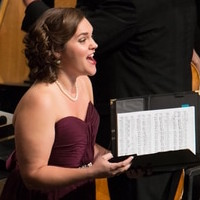
Soprano Natalie Ingrisano enjoys performing in the Pacific Northwest and Midwest, from intimate community concerts to Chicago’s United Center. Her solo appearances include Buxtehude’s Membra Jesu Nostri, Haydn’s The Seasons and The Creation, Mother in Amahl and the Night Visitors, Pergolesi’s Stabat Mater, the Bruckner and Mozart Requiems, Couperin’s Leçons de ténèbres, Handel’s Messiah, Charpentier’s Te Deum, Vivaldi’s Gloria, Monteverdi’s 1641 Vespers, a guest faculty-artist recital with organist David Schrader at Lyon College, and Mahler’s Symphony No. 4. As a chorister, she sang in the Grant Park Symphony Chorus before relocating to Seattle, where she is now a resident member of the Mägi Ensemble (with which she recently toured in Estonia) and frequently performs with the Byrd Ensemble and Emerald Ensemble. Ms. Ingrisano recently finished recording her first solo EP with harpsichordist Jillon Stoppels Dupree, and regularly appears with the East Coast–based Celtic band The Beggar Boys. She received her Bachelor and Master of Music degrees from the Chicago College of Performing Arts at Roosevelt University, is a graduate of the Artist Diploma in Early Music program at Cornish College of the Arts, and has studied Baroque dance with Anna Mansbridge for nine years.
learn more: natalieingrisano.com
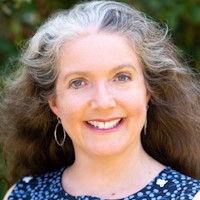
Originally from Australia and the U.K., choreographer, dancer and educator Anna Mansbridge now resides in Seattle. She holds a First-Class Honors Degree in Dance and Education from Bedford College and an MFA in Choreography and Performance from Mills College. After emigrating to the U.S. in 1998, she founded Seattle Early Dance, dedicated to recreating dances from the European Renaissance and Baroque periods. The ensemble has collaborated with local musicians and performed around the Pacific Northwest. Ms. Mansbridge has choreographed and directed opera productions in Europe and the U.S., including Gluck’s Orfeo ed Euridice and Purcell’s Dido and Aeneas with Pacific Musicworks, Lully’s Les Bourgeois Gentilhomme at Cornish Playhouse, and John Blow’s Venus and Adonis in Varazdin, Croatia. As a solo dancer, her recent performances include Dancing with the Sun King for the Whidbey Island Music Festival and Emperor of the Moon for the San Francisco Early Music Society. She has taught and reconstructed 18th-century European dances using Beauchamp-Feuillet notation at the University of Washington, Cornish College of the Arts and Utah Valley University.
learn more: seattlebachfestival.org
Program Notes
Opening and closing tonight’s program are works by Italian composer Claudio Monteverdi, whose life spanned the end of the Renaissance and the beginning of the Baroque era. His first opera, L’Orfeo, favola in musica (1607), is the earliest surviving opera still regularly performed today. In five acts, it relates the Greek legend of Orpheus, his love for Eurydice, and his attempts to rescue her from Hades. The opera opens with a toccata “to be played three times, with all the instruments, before the curtain is raised” that employs musical material also found in the opening chorus (“Domine ad adjuvandum”) of Monteverdi’s 1610 Vespers, leading scholars to believe that this fanfare was the personal entry music of the Duke of Mantua (Monteverdi’s employer at the time, who commissioned both works). Midway through this concert we also hear the closing number from L’Orfeo, “Vanne, Orfeo, felice e pieno,” in which nymphs and shepherds celebrate the ascension of Orpheus into heaven at the invitation of Apollo and dance a moresca.
At age 14, the Florence-born composer Giovanni Battista Lulli traveled to Paris, where he developed his talents as a violinist, guitarist, dancer, singer and composer, eventually finding his way into the employ of King Louis XIV. In 1662 he adopted the name Jean-Baptiste Lully and over the next decade enjoyed a fruitful collaboration with the playwright Molière. Their 1670 comédie-ballet (a spoken-word play incorporating music and dance) Le Bourgeois gentilhomme concerns a merchant who, aspiring to the aristocracy, seeks to marry off his daughter to a man masquerading as a Turkish nobleman.
A noted music theorist, Jean-Philippe Rameau dominated French opera during the last decade of his life, assuming a mantle once held by Lully (whose disciples very much disapproved of Rameau’s innovations). The four acts of Rameau’s Les Indes galantes (“The Amourous Indies”), an _opéra-ballet dating from 1735 and 1736, each visit a different exotic location, the last of which is North America: a Native American competes with a Spaniard and a Frenchman for the love of a woman, but all ends peacefully with the concluding chorus (“Forêts paisibles”).
During the early 18th century, German composers such as Johann Christoph Graupner, Johann Friedrich Fasch and Georg Philipp Telemann wrote dozens of “orchestral suites,” collections of instrumental dances with a grand opening movement called an ouverture (a creation of one Jean-Baptiste Lully) that featured an introduction in slow tempo (marked by dotted rhythmic patterns) followed by a faster fugal episode. (At the French court, Lully used this regal introductory movement to accompany the entrance of the sovereign prior to a performance of his ballet music.)
Johann Sebastian Bach, the most supremely talented of all Baroque composers, wrote at least four works that we call “orchestral suites,” but which he dubbed ouvertures after the style of their opening movements. He may have created early versions of these works during his time at Anhalt-Köthen, where from 1717 through 1723 he concentrated on producing instrumental music and other secular pieces for Prince Leopold, but the surviving versions of his four suites likely date from his time in Leipzig, where in 1723 he took up a post that he held until his death. Scored for the smallest forces (solo flute, strings and continuo), the second of these suites features a “Badinerie” (from the French badiner, “to jest”) as its concluding movement.
Part of Bach’s duties as Cantor and Director of Music at St. Thomas’ Church and Choir School in Leipzig involved providing music for each Sunday’s church service (except for the Lenten periods preceding Christmas and Easter), as well as various feast days — roughly 60 dates per year. Although he could have performed pre-existing music, on Trinity Sunday 1723 Bach set about composing a new cantata for each of these occasions. He then repeated the process for 1724–1725, and then again for 1725–1726, and again for 1728–1729. “Ach wie flüchtig, ach wie nichtig” (“Ah, how fleeting, ah how insignificant”) is one of roughly 40 cantatas in Bach’s second cycle that took the form of a chorale cantata, for which the entire piece (both text and melody) is based on a single Lutheran hymn. “The instrumental ritornello to the opening chorale fantasia of BWV 26,” writes Bach biographer John Eliot Gardener, “is a stupendous musical confectionery illustrating the brevity of human life and the futility of earthly hopes.”
Bach occasionally composed cantatas for secular purposes, including a work to commemorate the 34th birthday of Maria Josepha, Queen of Poland and Princess Elector of Saxony, that premiered on December 8, 1733. Scored for an orchestra including three trumpets and timpani, “Tönet, ihr Pauken! Erschallet, Trompeten!” (BWV 214) begins with a jubilant D-major choral dance in A–B–A form and 3/8 time. The following year, he repurposed this music as “Jauchzet, frohlocket,” the opening movement in the first of six cantatas that comprise his Christmas Oratorio (BWV 248).
At the end of his life, the Italian composer Arcangelo Corelli (not represented tonight — cast your votes now for Baroque Bangers, Vol. 2) prepared a set of 12 concerti grossi for publication; they appeared in 1714, shortly after Corelli’s death, as his Op. 6. Each was scored for strings, with solo parts for two violins and a cello. In 1739, the German-born George Frideric Handel implicitly paid tribute to Corelli with his own great set of 12 concerti, also Op. 6, which Handel’s publisher sold by subscription for a fee of two guineas, attracting over 100 musicians and members of the English aristocracy. While Corelli refined his concerti through years of performances, Handel produced his set in about five weeks; he was able to work so quickly in part because he recycled several of the concerto movements from compositions for other forces (and in some cases from music by other
composers). “The running opening motive of the [second-movement] Allegro” from Op. 6, No. 12, notes Martin Pearlman, “derives from the aria ‘Nel mondo e nell’abisso,’ which Handel originally composed for his opera Riccardo primo and which he used again in a later version of Tamerlano.”
Born the same year as J.S. Bach, Georg Friedrich Händel (as he was christened), grew up in Halle, Germany, before moving to Hamburg and then heading to Italy, where he sought to learn the art of Italian opera. Upon his return to Germany, Handel made a stop at the court of Georg Ludwig, Elector of Hanover, who hired Handel as his Kapellmeister and then immediately granted him leave to visit London, where Italian opera was just coming into vogue: Handel made a splash with several such works. In 1714, Georg Ludwig ascended to the British throne as King George I. The new monarch inherited the court composers of his predecessor, so Handel had no official position in spite of George I previously being his de facto employer, but he remained in London with the king’s blessing.
From Rinaldo in 1711 to Deidamia in 1741, Handel composed some three dozen Italian-language operas for English audiences, until competition from English-language operas that appealed to a wider public helped spur Handel’s transition to a brand-new genre: English-language oratorio. One of the works of this type most frequently performed during Handel’s lifetime was his 1736 Alexander’s Feast, set to a libretto by John Dryden, in which Alexander the Great hosts a banquet in Persepolis, a Persian city captured by his forces. The second act opens with the bard Timotheus, who in the first act has praised Alexander as a god and moved him to tears, beginning to incite the leader to rage and revenge.
One of the occasions for which Handel composed music for George I was a July 17, 1717, concert on the River Thames. A royal barge set sail from Whitehall Palace toward Chelsea, followed by a second barge holding 50 musicians, who performed Handel’s Water Music no fewer than three times as the procession made its way up the Thames and back. The selection heard this evening comes from the first of three suites Handel composed for the event. A decade later, on February 20, 1727, the House of Lords passed legislation naturalizing the German composer and George I granted his assent, making Handel a British citizen. When George I died less than four months later, his son ascended to the throne as George II.
To celebrate the 1748 treaty of Aix-la-Chapelle, ending the War of Austrian Succession, George II staged a festive evening in London’s Green Park on April 27, 1749, featuring music written for the occasion, accompanied by a massive fireworks display. Handel immediately (albeit somewhat reluctantly) acquiesced and even followed the monarch’ edict not to include any stringed instruments in his orchestra, assembling a massive band of double reeds, brass and percussion. The work begins with a grand overture in the French style, with a regal introduction leading to a vigorous fugal Allegro in triple meter, all in glorious D major.
Although Handel’s oratorios were largely on biblical subjects, Semele (1744) concerns the title character, daughter of King Cadmus of Thebes, engaging in an affair with the god Jupiter, to the great displeasure of Juno, Jupiter’s wife. Act I opens with Cadmus seeking approval at the temple of Juno for Semele’s betrothal to Athamas, Prince of Boeotia.
A generation before Handel became England’s most famous resident composer, Henry Purcell reigned as the country’s preeminent musical figure (and, as many would have it, the last great homegrown composer until Edward Elgar). In honor of the 15th wedding anniversary of King William III and Queen Mary II in 1692, he composed five masques for The Fairy Queen, a semi-opera adapting Shakespeare’s A Midsummer Night’s Dream. “Now Joyn your Warbling Voices” comes from an Act II masque for Titania. And mere months before his own death at age 36, Purcell wrote several pieces of music for the March 5, 1695, funeral of Mary II at Westminster Abbey, including the solemn march heard this evening.
During the last five years of his life, Purcell composed incidental music for no fewer than 40 Restoration plays. While some of these productions merited only an odd song or two, many benefited from rich and varied collections of airs and dances. Indeed, Purcell composed some of his finest instrumental music for the theater. Abdelazer (or The Moor’s Revenge), written by Mrs. Aphra Behn, was first staged in 1676 and published the following year. Purcell provided incidental music for a 1695 revival: an overture and eight instrumental pieces, as well as a song. The Rondeau has become one of Purcell’s most famous tunes due to its appropriation by Benjamin Britten as the theme for his set of symphonic variations known as A Young Person’s Guide to the Orchestra.
A year before the death of Queen Mary II, Purcell contributed an ode, Come Ye Sons of Art, for the monarch’s birthday festivities. Originally a countertenor duet, “Sound the Trumpet” is heard this evening in a version for soprano and trumpet.
The Venice-born composer Antonio Vivaldi was a master of the concerto form, writing an astounding 230-plus for solo violin and orchestra (including his most famous quartet of works, The Four Seasons) and 39 for bassoon (sadly, not represented on tonight’s program — cast your votes now for Baroque Bangers, Vol. 2). In addition, there are a number of concertos for two or more soloists, such as RV 531, a concerto in G minor for two cellos, likely composed during the 1720s. Unusually, the first movement begins with the two soloists (rather than an opening statement from the orchestra before the initial solo entrance).
Vivaldi also composed at least seven concertos for the viola d’amore, an archaic instrument with six or seven strings, plus several additional “sympathetic strings” that would resonate when the main group of strings were bowed. Michael Tabolt has theorized that the composer’s spelling of the instrument as “AMore” in RV 397 and one other concerto for this unusual instrument is an allusion to “Anna Maria,” one of Vivaldi’s students at the Ospedale della Pietà (a Venetian orphanage and music school where he taught for three decades) who remained at the school her entire life, and for whom Vivaldi wrote a number of other concertos.
Although Vivaldi claimed to have written 94 operas, music historians have only documented 50 or so, many of which have been lost. His only surviving oratorio, Juditha triumphans (1716), relates the story of Judith (from the biblical Apocrypha), a widow who seduces an Assyrian general and beheads him, saving her city. (The plot served as an allegory for a victory by Venetian forces over the Turks at the siege of Corfu earlier that year.) In the rage aria “Armatæ face,” one of the general’s servants reacts to the beheading by pleading for the Furies to enact revenge on those responsible.
— Jeff Eldridge