
mainstage series
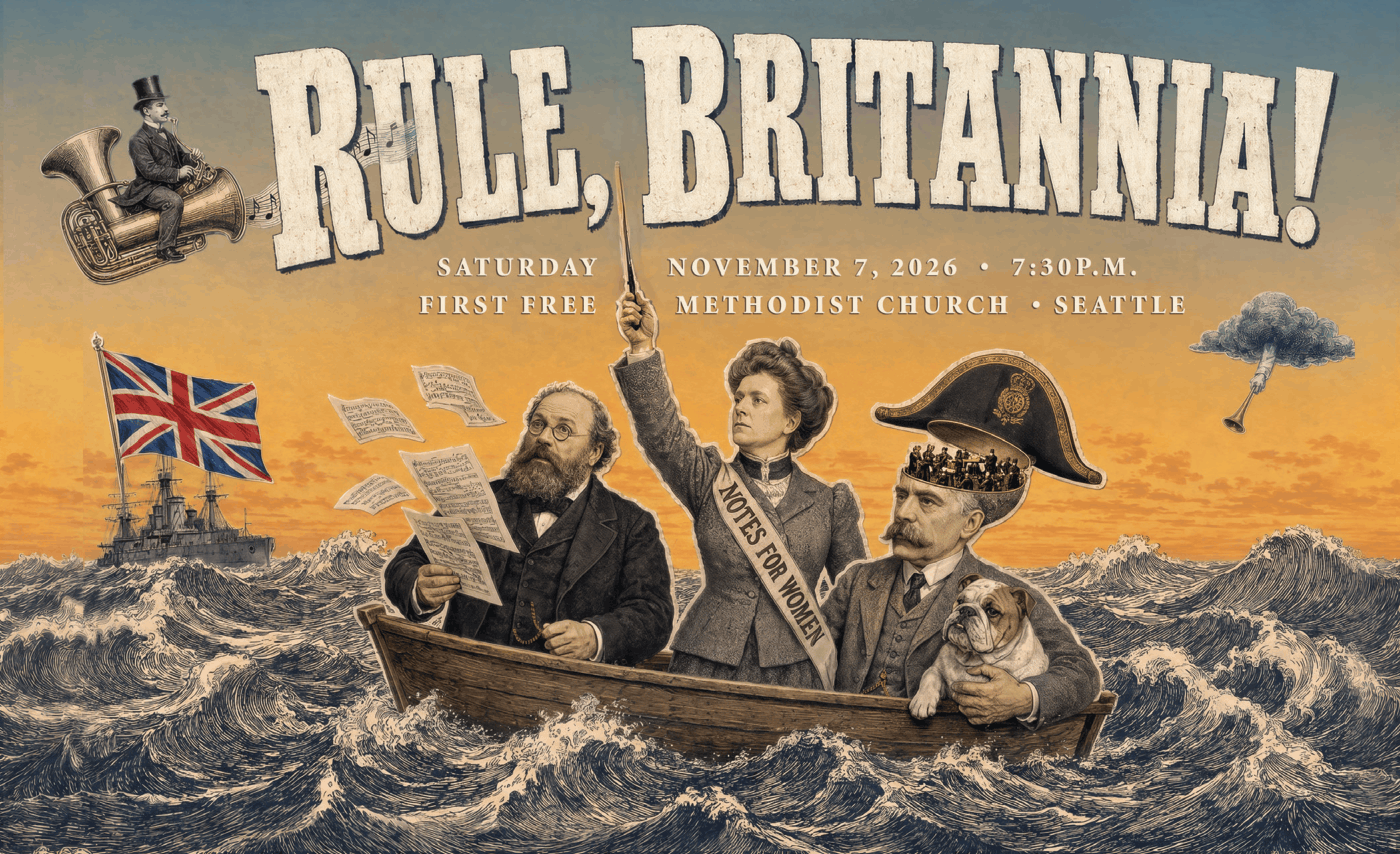
Saturday, November 7, 2026 • 7:30 p.m.
First Free Methodist Church (3200 3rd Ave W, Seattle)
Harmonia Orchestra & Chorus
William White, conductor
Zachary Lenox, baritone
Program
Ethyl Smyth (1858–1944)
Overture to The Boatswain’s Mate
Charles Villiers Stanford (1852–1924)
Songs of the Fleet, Op. 117
— intermission —
Edward Elgar (1857–1934)
Variations on an Original Theme, Op. 36 (“Enigma”)
About the Concert
Set sail for the Edwardian Era with Sir Charles Villiers Stanford’s brilliant evocation of the sea, in a program christened with a rollicking overture from Dame Ethel Smyth and anchored by Sir Edward Elgar’s immortal “Enigma” Variations.
- This performance will last approximately two hours, including one intermission.
- Join music director William White for a pre-concert talk beginning at 6:30 p.m.
Solo Artist
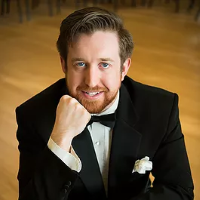
Praised for “a broad, resonant baritone that is exquisitely controlled throughout his entire range,” Zachary Lenox has performed across North America, including the roles of Silvio (Pagliacci), Marcello (La Bohème), Marullo (Rigoletto), Count Almaviva (Le nozze di Figaro), Guglielmo and Don Alfonso (Così fan tutte), Papageno (Die Zauberflöte), Father (Hansel and Gretel), Sid (Albert Herring), Gianni Schicchi and Betto (Gianni Schicchi), and Dick Deadeye (H.M.S. Pinafore). He has appeared with Portland Opera, Opera Parallèle, Pacific Music Works, Cascadia Chamber Opera, Portland Summerfest, Portland Chamber Orchestra, Portland Concert Opera, Eugene Concert Choir, Bravo Northwest and the Astoria Music Festival. Concert appearances include Handel’s Messiah, Samson and Judas Maccabeus, Haydn’s Lord Nelson Mass, Schubert’s Mass in G, the Verdi and Fauré Requiems, and many works of J.S. Bach, including both the role of Jesus and the baritone arias in the St. Matthew Passion with Harmonia. Engagements during the 2025–2026 season included Orff’s Carmina Burana with both the Vancouver (WA) Symphony and the Willamette Master Chorus, Bach’s BWV 147 with Epiphany Seattle, the role of Mr. Gobineau in Menotti’s The Medium with Ping & Woof Opera, Mozart’s Requiem with the Auburn Symphony, and the world premiere of William C. White’s Dies Irae with Harmonia.
- Learn more: zacharylenox.com
Program Notes
Edward Elgar
Variations on an Original Theme, Op. 36
Edward William Elgar was born in Broadheath, England, on June 2, 1857, and died at Worcester on February 23, 1934. He composed his “Enigma” Variations in 1898 and 1899. The first performance was given in London on June 19, 1899, under the direction of Hans Richter; soon after, Elgar revised the finale. The score calls for pairs of flutes (one doubling piccolo), oboes, clarinets and bassoons, contrabassoon, 4 horns, 3 trumpets, 3 trombones, tuba, timpani, snare drum, bass drum, triangle, cymbals, (optional) organ and strings.
Elgar’s “Enigma” Variations, each of which characterize a friend of the composer’s, met with an ecstatic reception from public and critics alike, who heralded Elgar as the first great English composer since Henry Purcell. The “Enigma” of the familiar version of the work’s title is threefold: At the premiere, Elgar’s “friends pictured within” were identified only by initials (the composer later provided an explanation for each, excerpts of which appear below); the inspiration for the theme was not identified (although Elgar later revealed privately that he himself was the subject); most intriguingly, Elgar hinted that there was a hidden theme, a well-known tune that was never heard. This prompted much speculation, but Elgar (and three others in whom he confided) all died without revealing the secret.
Caroline Alice Elgar, the composer’s wife, is given the first variation, “a prolongation of the theme with what I wished to be romantic and delicate additions.” Hew David Stuart-Powell was an amateur pianist with whom Elgar played chamber music. “His characteristic diatonic run over the keys before beginning to play is here humorously travestied.” Richard Baxter Townshend was a popular author and amateur singer whose resonant bass voice is parodied by the bassoons, “flying off occasionally into ‘soprano’ timbre.” William Meath Baker, “a country squire, gentleman and scholar,” is characterized as he barks out the day’s agenda to his houseguests; woodwinds suggest “the teasing attitude of the guests” and the variation concludes “with an inadvertent bang of the door.”
Richard Penrose Arnold, the son of poet Matthew Arnold, “was a great lover of music, which he played (on the pianoforte) in a self-taught manner … but suggesting in a mysterious way the real feeling.” Ysobel was Miss Isabel Fitton, a violin student of Elgar’s before she switched to the viola (which has a prominent solo part). Arthur Troyte Griffith, an architect, was also an amateur musician; Elgar portrays his “maladroit essays to play the pianoforte … the final despairing ‘slam’ records that the effort proved to be in vain.” Miss Winifred Norbury was known for her love of music; her “characteristic laugh” is suggested musically.
Nimrod was Elgar’s closest friend, the music critic August Jaeger (whose surname is German for “hunter”; Nimrod was a hunter in the Old Testament). This noble music was inspired by a discussion between Jaeger and Elgar about Beethoven’s slow movements.
Dorabella (after the character in Mozart’s Così fan tutte) was Elgar’s nickname for Dora Penney, whose distinctive speech patterns the composer recreates musically. George Robertson Sinclair, an organist at Hereford Cathedral, was the proud owner of a great bulldog that one day fell into the River Wye and paddled upstream; “G.R.S. said, ‘Set that to music.’ I did; here it is.”
Basil G. Nevinson, an amateur cellist who played trios with Elgar and Stuart-Powell, is given a variation with a prominent cello solo. *** is often said to represent Lady Mary Lygon: she had set sail for Australia (hence the quotation of Mendelssohn’s Calm Sea and Prosperous Voyage) and permission to use her initials could not be obtained.
E.D.U. — or “Edoo” — was Alice Elgar’s nickname for her husband. This self-portrait quotes the C.A.E. and Nimrod variations and “the whole work is summed up in the triumphant broad presentation of the theme in the major.”