
mainstage series
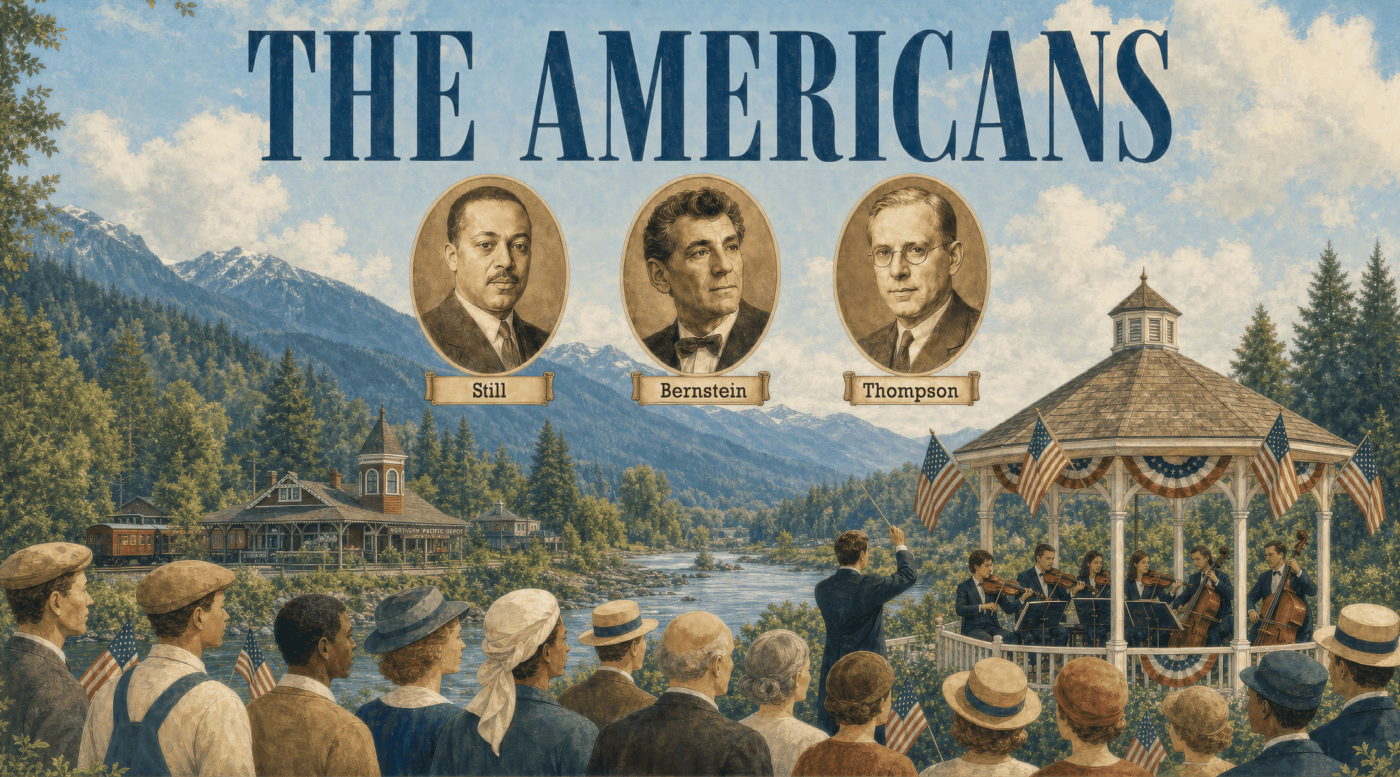
Saturday, May 1, 2027 • 7:30 p.m.
First Free Methodist Church (3200 3rd Ave W, Seattle)
Harmonia Orchestra & Chorus
William White, conductor
Program
William Grant Still (1895–1978)
Wood Notes
Leonard Bernstein (1918–1990)
Chichester Psalms
— intermission —
Randall Thompson (1899–1984)
Symphony No. 2 in E minor
About the Concert
Three snapshots from the American century: the New Deal optimism of Randall Thompson’s second symphony, the post-WWII respite of William Grant Still’s Wood Notes, and the Vietnam Era pathos of Leonard Bernstein’s Chichester Psalms.
- This performance will last approximately one hour and 45 minutes, including one intermission.
- Join music director William White for a pre-concert talk beginning at 6:30 p.m.
Program Notes
Randall Thompson
Symphony No. 2 in E minor
Ira Randall Thompson was born April 21, 1899 in New York City, and died on July 9, 1984, in Boston. He composed his Symphony No. 2 in Gstaad, Switzerland, between July 1930 and September 1931. Howard Hanson conducted the premiere with the Rochester Philharmonic on March 24, 1932. The symphony is scored for three each of flutes (one doubling piccolo), oboes (one doubling English horn), clarinets and bassoons, 4 horns, 3 trumpets, 3 trombones, tuba, timpani, cymbals, and strings.
Although he is now best remembered for his choral music, it was Randall Thompson’s Symphony No. 2 that put him on the map as a composer. Thompson provided the following remarks about this work:
It is based on no program, either literary or spiritual. It is not cyclical. I wanted to write four contrasting movements, separate and distinct, which together should convey a sense of balance and completeness.
I have used the ordinary full orchestra by threes. I have not used all the instruments in every movement. Limiting the percussion to cymbals and kettledrums [timpani] may seem to be a curious twist for a contemporary composer. I have been sparing in my use of percussive punctuation in an attempt to make the music itself intrinsically rhythmic. The kettledrums are used only in the first two movements; the cymbals only in the last two. The orchestra is greatly reduced in the second movement. The brass in the scherzo is limited to horns and one trumpet. The trombones and tuba are employed only in the last movement.
The symphony is dedicated to my wife.
An analysis follows:
I. Allegro, E minor, 2/4 time. The principal theme is announced immediately by the horns, forte, and answered by the trumpets. From this motive is derived a series of rhythmic figures which form the toccata-like background of the entire movement. The subsidiary theme (G minor, oboes, English horn and bassoon) is of a more reticent nature, but the violoncellos accompany it in a persistent rhythm.
The development section begins quietly, and forms a gradual crescendo, at the apex of which the first theme returns in an ominous fortissimo against a counter-rhythm on the kettledrums. A more extended transition leads to a sinister presentation of the second theme (C minor, muted trumpets answered by bassoons and clarinets antiphonally). At the close, a major version of the second theme in augmentation is sounded fortissimo by the horns and trumpets against the continuous pulse of the strings. The movement subsides, apparently to end in the major. An abrupt minor chord brings it to a close.
II. Largo, C major, 4/4 time. The violins play a warm, quiet melody against pizzicato chords in the violoncellos. A contrasting melody is sung by the oboe. The movement is not long, but its mood is concentrated. It ends imply, on a C major chord with lowered seventh.
III. Vivace, 7/4 time. Scherzo with trio. The first section begins in G minor and ends in D minor. The trio (Capriccioso, 6/8 and 9/8 time) progresses from B major to G major. The first section returns transposed. Now beginning in C minor and ending in G minor, it serves as a kind of extended “subdominant answer” to its former presentation. There is a short coda making intensified use of material from the trio.
IV. _Andante moderato_ — _Allegro con spirito_ — — Largamente, E major. The slow sections which begin and end this movement serve to frame the Allegro, a modified rondo.
The theme of the Allegro is a diminution of the theme of the first and last sections. The Largamente employs for the first time the full sonorities of the orchestra in a sustained assertion of the principal melody.
The symphony would go on to win great acclaim — it received over 500 performances worldwide in the decade immediately following its premiere. Yet in later years, the very accessibility that afforded the work its instant popularity grew unfashionable to a musical establishment increasingly enamored with serialism and the avant garde. Despite the recent revival of interest in Thompson and his contemporaries, this jewel of American symphonic music remains unknown to the vast majority of musicians and audiences and is rarely heard in concert.
For a 1968 performance by Leonard Bernstein and the New York Philharmonic (subsequently recorded and available on YouTube), Edward Downes provided the following appreciation of the work for the Philharmonic program book:
Randall Thompson’s Second Symphony dates — but how deliciously it dates! With what grace its melodies can sing! With what dexterity the rhythms of the first movement evolve from one another, and all from the faintly jazzy opening theme. With what a steady pulse the long line of the slow movement flows from its very opening phrase. For some reason, perhaps the pizzicato accompaniment of the violin melody, the Largo irresistibly recalls (to this listener) the popular Air from Bach’s D-major Orchestral Suite. And when Mr. Thompson’s melody blossoms into counterpoint, additional Baroque slow movements come to mind with their seemingly endless inter-arching curves of song.
How infectious is the underplayed humor of the Scherzo with its jaunty refrain and its capricious middle section. The movement ends with a sort of musical wisecrack, reminding us that the original meaning of scherzo is “joke.”
Although weightier matters are broached in the introduction and coda to the last movement, the lively syncopations of its principal sections recall an old-fashioned American cakewalk.
In this extraordinarily ingratiating score he achieved the very rare distinction of being popular without being shallow. The Second Symphony seems almost an illustration of this belief that “a composer’s first responsibility is … to write music that will reach and move the hearts of its listeners in his own day.”