
mainstage series
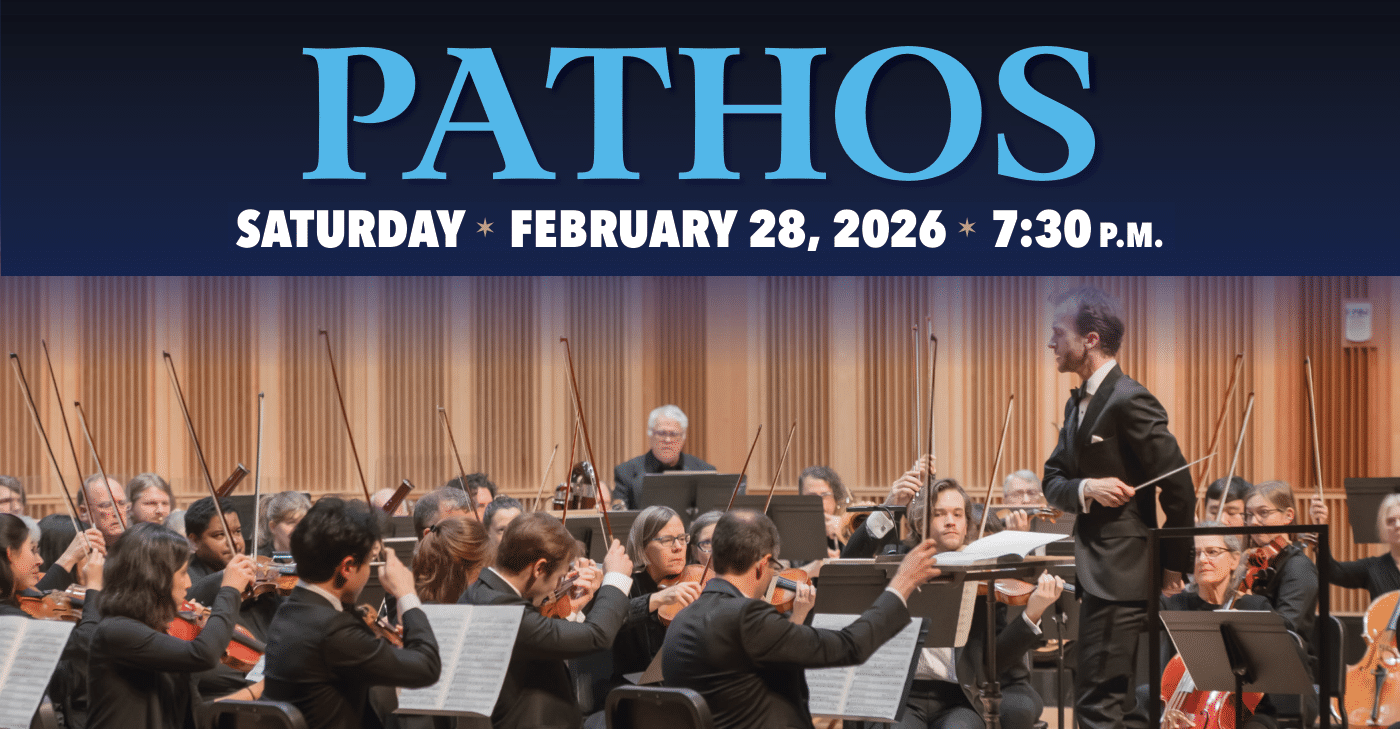
Saturday, February 28, 2026 • 7:30 p.m.
Northshore Concert Hall (15500 Simonds Rd NE, Kenmore)
Harmonia Orchestra & Chorus
William White, conductor
Hsing-Hui Hsu, conductor
Rachel Lee Priday, violin
Program
Jean Sibelius (1865–1957)
Karelia Overture
Carlos Garcia (*1991)
Violin Concerto [world premiere]
— intermission —
Piotr Ilyich Tchaikovsky
Symphony No. 6 in B minor, Op. 74 (“Pathétique”)
About the Concert
Everett native Carlos Garcia is a musician who can seemingly do everything: in his young career he has composed music for Marvel films, Disney theme parks and (most impressively of all) Harmonia. Carlos also plays a mean fiddle, and that’s why it’s so exciting to have him collaborate with another major talent (and Harmonia favorite), Rachel Lee Priday, on a new work for violin and orchestra. Music of Sibelius and Tchaikovsky — written in the frozen north but burning with red-hot passion — bookends the program.
Maestro’s Prelude
Dear Music Lovers,
If you have come to our concert tonight looking for a gripping emotional experience, you have indeed arrived at the right place.
Piotr Ilyich Tchaikovsky — known as the composer of some of the most passionate music in the canon — lays his soul bare in this, his final symphony. With its soaring melodies and searing climaxes, the “Pathéthique” was one of the pieces that first grabbed me as a teenaged classical-music obsessive, and it hasn’t let me go ever since. I consider the defining moment of this piece to be the transition from the red-hot ending of the third movement to the ice-cold dowsing that opens the fourth. I’ll speak more on this subject from the stage, but this is one case where I would ask you very kindly to hold your applause between movements so that we can all share this plangent experience together.
One way in which I identify very strongly with Jean Sibelius is that he too was a Tchaikovsky freak as a young musician. So much so, in fact, that Sibelius’ first symphony is sometimes referred to as “Tchaikovsky’s seventh,” in much the same way that Brahms’ first is sometimes called “Beethoven’s tenth.” (This in spite of the fact that Tchaikovsky actually composed eight symphonies — more about that fact in the program notes.) The Karelia Overture is peak Tchaikovskiana — incidentally, written in exactly the same year as the “Pathétique” symphony — but already Sibelius’ distinct compositional voice practically leaps off the page. I’m delighted that our orchestra’s assistant conductor, Hsing-Hui Hsu, will conduct this work tonight in her latest appearance on our concert stage.
Of course, a concert is never more exciting than when it features a world premiere, so I hope that you have arrived at the hall tonight with a giddy curiosity and a sense of occasion. It was my idea to pair the composer, Carlos Garcia, with the soloist, Rachel Lee Priday, and I have to say, I think it was one of my more inspired notions. Carlos is a fantastic violinist himself and thus the perfect person to write a virtuosic showpiece for an artist of Rachel’s caliber. The last piece that Carlos wrote for us was a huge hit, and I have every confidence that this new work will become an instant favorite with all of you who are lucky enough to be present at its inception.
— William White
P.S. I want to make sure that I make special mention of the fact that tickets are now on sale for our season finale concert, which will take place at Benaroya Hall on Friday, May 8. If you’re a fan of big orchestral works like Tchaikovsky’s sixth, you will not want to miss our performance of Holst’s The Planets and the trenchant choral-orchestral psalms of Lili Boulanger.
Solo Artists
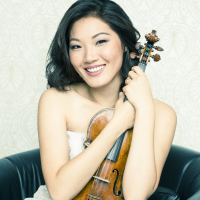
A consistently exciting artist, renowned globally for her spectacular technique, sumptuous sound, deeply probing musicianship, and “irresistible panache” (Chicago Tribune), violinist Rachel Lee Priday has appeared as soloist with major international orchestras, among them the Chicago, Houston, National, Pacific, St. Louis and Seattle Symphony Orchestras, Boston Pops Orchestra, Buffalo Philharmonic and Germany’s Staatskapelle Berlin. Her distinguished recital appearances have brought her to eminent venues, including Lincoln Center’s Mostly Mozart Festival, Chicago’s Ravinia Festival and Dame Myra Hess Memorial Series, Paris’ Musée du Louvre, Germany’s Mecklenburg-Vorpommern Festival and Switzerland’s Verbier Festival.
Passionately committed to new music and creating enriching community and global connections, Ms. Priday’s wide-ranging repertoire and multidisciplinary collaborations reflect a deep fascination with literary and cultural narratives. Her work as soloist with the Asia/America New Music Institute promoted cultural exchange, combining premiere performances with educational outreach in the US, China and Vietnam. She has premiered and commissioned works by composers including Matthew Aucoin, Christopher Cerrone, Gabriella Smith, Timo Andres, Leilehua Lanzilotti, Cristina Spinei, Melia Watras and Paul Wiancko. In 2022, she premiered a new concerto, Kuyén, written for her by Miguel Farías, which depicts the Moon in Mapuche mythology, with the UC Davis Symphony.
Recent season highlights have included a duo recital with composer/pianist Timo Andres in Seattle and for the Phillips Collection, exploring the throughlines of American twentieth and twenty-first century violin and piano works, and a third tour of South Africa, where she appeared in recital and performed the José White Lafitte Concerto with the Johannesburg and Kwazulu-Natal Philharmonics. Upcoming and recent concerto engagements include the Portland Symphony, Springfield (MO) Symphony, Pensacola Symphony, Symphony San Jose, South Carolina Philharmonic, and Bangor Symphony.
Rachel Lee Priday began her violin studies at the age of four in Chicago before moving to New York to study with the iconic pedagogue Dorothy DeLay; she continued her studies at the Juilliard School Pre-College Division with Itzhak Perlman. She holds a BA in English from Harvard and an MM from the New England Conservatory, where she worked with Miriam Fried. In 2019, she joined the faculty of the University of Washington School of Music as Assistant Professor of Violin. Ms. Priday has been profiled in The New Yorker, The Strad, Los Angeles Times and Family Circle. She performs on a Giuseppe Guarneri violin (“filius Andreae”).
- Learn more: rachelleepriday.com
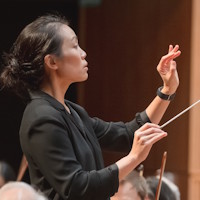
Conductor Hsing-Hui Hsu is in her second season as Harmonia’s assistant conductor. She is also the music director and co-founder of the Emerald City Chamber Orchestra, a Seattle-based ensemble specializing in string repertoire. She has been a guest assistant conductor with the Seattle Symphony, and has also guest-conducted the Seattle Collaborative Orchestra, Saratoga Orchestra, Seattle Festival Orchestra and Puget Sound Symphony Orchestra. She was a founding member of the Amazon Symphony Orchestra and served as its music director, collaborating with other arts organizations in the Seattle area as well as charitable organizations such as Mary’s Place.
In addition to conducting, she is an active clarinetist. Last season, she served as acting principal clarinetist with the Yakima Symphony Orchestra, where she is also bass clarinetist. She has played with the Pacific Northwest Opera, Sustain Music Project, Tacoma Opera, Seattle Philharmonic, Philharmonia Northwest, Seattle Metropolitan Chamber Orchestra and Puget Sound Symphony Orchestra. She received her Bachelor of Music in clarinet performance from Rice University, where she also served as music director of the Rice Light Opera Society.
Program Notes
Jean Sibelius
Karelia Overture, Op. 10
Sibelius was born in Tavestehus, Finland, on December 8, 1865, and died at Jävenpää on September 20, 1957. He composed this work in 1893 and conducted the premiere on November 13 of that year. The score calls for pairs of woodwinds, 4 horns, 3 trumpets, 3 trombones, timpani, percussion (tambourine, triangle and bass drum) and strings.
Sibelius was not merely the most famous composer Finland ever produced,” writes Alex Ross in The Rest Is Noise, “but the country’s chief celebrity in any field.” Until marathoner Paavo Nurmi captured two gold medals at the 1920 Olympics, Michael Steinberg notes, “Sibelius was the only Finn whose name was known throughout the world.” Even today, as Ross points out, “[w]hen Finns are asked to characterize their culture, they invariably mention, along with such national treasures as the lakeside sauna, Fiskars scissors, and Nokia cell phones, ‘our Sibelius.’ ”
The son of a Swedish-speaking doctor (who died of typhus before the boy reached age three), Sibelius learned Finnish at prep school, later changing his given name of Janne to the French Jean. He originally sought a career as a celebrated violinist until a disastrous 1891 audition for the Vienna Philharmonic shifted his focus to composition. “I think I am now on the right path,” he wrote to his soon-to-be wife later that year. “I now grasp those Finnish, purely Finnish tendencies in music less realistically but more truthfully than before.”
The 1892 premiere of his massive Kullervo Symphony, which includes a male chorus singing texts from the Kalevala, Finland’s national epic, helped put him on the map as a composer. The following year, the Viipuri Student Association commissioned Sibelius to compose music to accompany tableaux relating the history of the town of Viipuri and the surrounding Karelian isthmus from the 13th through early 19th centuries. Long a region of contention between Swedish-ruled Finland and Russia, the territory was eventually ceded to the Soviet Union at the end of World War II (and the city is now know as Vyborg).
Sibelius’ Karelia music consists of an overture, eight tableaux and two intermezzos. The composer complained about the raucous crowd at the initial performance (“you couldn’t hear a single note of the music — everyone was on their feet cheering and clapping”) and about needing to accept that commission in the first place (“I think I have been brought down really low when I have been forced to compose for money”) but 10 days later he conducted the overture and selections from the other movements under more pleasant circumstances.
In 1906, after achieving widespread success with the tone poem Finlandia, his Symphony No. 2 and his violin concerto, Sibelius published the overture as his Op. 10 and a three-part suite collected from the other 10 movements as his Op. 11, the latter becoming one of his most-performed compositions.
Rosa Newmarch, a British expert on Russian music who authored a 1906 profile of Sibelius (and maintained a correspondence with the composer for more than three decades thereafter), wrote: “Karelia forms the extreme southeastern province of Finland, and lies between the Gulf of Finland on the west and the desolate shores of Lake Ladoga on the east. Less picturesque as regards scenery than the western province, Karelia is particularly interesting as having been the stronghold of the national spirit and the depository of national myths. ‘The Karelian,’ says a well-known Finnish writer, ‘represents the bright, the Tavast the dark side of the Finnish type.’ He is more slender and brisk, more lively and sensitive, although less steady than his compatriots, ‘a born poet and a born trader.’ … The Karelian peasantry are cheerful companions.
“The overture addresses the listener directly. The first theme is distinct and somewhat warlike in character; in contrast, a lyrical melody appears, more contemplative than melancholy, which seems to echo from the solitude of a northern lake. The music has song and color and is of a healthy, vigorous nature, offering a welcome change from the sentimental style of certain modern schools and the warbling undercurrents and tempi rubati of others. The use of the fourth in an oboe phrase — the effect being that of a shawm or a hunting call faintly echoing across lonely landscapes — reminds us of a very similar musical phrase that recurs throughout Borodin’s First Symphony and seems to have an almost local significance.”
Carlos Garcia
Concerto for Violin and Orchestra
Garcia was born October 20, 1991, and now lives in Los Angeles. He composed this concerto in 2025, on commission from Harmonia. The work receives its premiere this evening. In addition to solo violin, the score calls for pairs of woodwinds (with one flute doubling piccolo), 3 horns, 2 trumpets, timpani, percussion (bowed crotales, glockenspiel, triangle, cymbals, suspended cymbals, bell tree and Mark tree), harp, celesta and strings.
A native of the Pacific Northwest, Carlos Garcia began his musical training at age seven, when he started playing piano and violin. After purchasing his first CD at age eight (Vivaldi’s Four Seasons) he became fascinated by the orchestra and film soundtracks. This led to an undergraduate degree in music composition and violin performance from Western Washington University, as well as a master’s degree in film scoring from Seattle Film Institute, where he studied with Emmy-winning composer Hummie Mann.
After working as an assistant for TV composer Ron Jones (Family Guy, Star Trek: The Next Generation), in 2021 Garcia moved to Los Angeles, where he began collaborating with Christophe Beck, composing additional music cues and arrangements for such projects as DC’s Shazam! Fury of the Gods, Marvel’s Ant-Man and the Wasp: Quantumania and
Agatha All Along, and the upcoming The Sheep Detectives. He now joins such Hollywood luminaries as Erich Wolfgang Korngold, Miklós Rózsa and John Williams in writing a concerto for violin and orchestra.
“Since the days of playing in the violin section for Harmonia years ago (hiding behind the last stand),” writes Garcia, “it truly feels like a full-circle moment to have the honor of writing a new violin concerto. As a violinist myself, the task to write a concerto for the instrument is both exciting and daunting, with so many of my favorite works from the violin repertoire being concertos. Before the composition process began last year, I was introduced to the incredible playing of Rachel Lee Priday and was blown away by her powerful sound and bold approach to new music. After binge-watching all of her YouTube videos, I got to work and completed the concerto in about five months.
“The concerto is in three movements, structured in a traditional fast–slow–fast format. The opening movement, ‘Cinematic Sketches,’ introduces the main themes. The opening three chords and descending melody set the scene, followed by a sixteenth-note riff in the violin serving as the thematic backbone of the rest of the movement. Relying heavily on rhythmic motifs and dramatic texture changes, the music presents a challenge for both soloist and orchestra.
“The second movement, ‘Resonance,’ is a love theme. The opening woodwind melody, when given numbers within the scale, spells out 9–1–6–2–4, signifying September 16, 2024, the day I met my wonderful wife, Sevana, to whom this concerto is dedicated (and by whom this concerto was proofread). Because we also met as stand partners in our community orchestra, it seemed appropriate to end the movement with an exchange between two violins, playing closer and closer in pitch until they reach a unison note.
“The finale, ‘Escapades,’ is an adventure theme. Meant to be bright and optimistic, the syncopated melody feels as if it is leaning boldly forward into the future. The concerto ends with a repeat of the opening chords and theme from the first movement in a grandiose, triumphant fashion as the solo violin ramps up relentlessly toward the finish.”
Piotr Ilyich Tchaikovsky
Symphony No. 6 in B minor, Op. 74 (“Pathétique”)
Tchaikovsky was born in Votkinsk, Russia, on May 7, 1840, and died in St. Petersburg on November 6, 1893, just nine days after conducting the premiere of this, his final symphony. Composed between early February and late August of 1893, the score calls for pairs of woodwinds (plus a third flute, doubling piccolo), 4 horns, 2 trumpets, 3 trombones, tuba, timpani, percussion (cymbals, bass drum, tam-tam) and strings.
“Let’s get this clear,” writes Scottish music journalist Tom Service. “Tchaikovsky’s Pathétique Symphony is not a musical suicide note, it’s not a piece written by a composer who was dying, it’s not the product of a musician who was terminally depressed about either his compositional powers or his personal life, and it’s not the work of a man who could go no further, musically speaking.”
Upon returning from an American concert tour in May 1891, Tchaikovsky began sketching material for a new symphony with the following outline: “The ultimate essence of the plan of the symphony is Life. First part — all impulse, passion, confidence, thirst for activity. Must be short (the finale death — result of collapse). Second part love; third disappointments; fourth ends dying away (also short).” The resulting work, in E♭ major and completed in sketch form by November 4, 1892, does not adhere to this plan — nor did it satisfy its composer, who abandoned it the following month.
“The symphony is only a work written by dint of sheer will on the part of the composer; it contains nothing that is interesting or sympathetic,” he wrote to his nephew Vladimir “Bob” Davydov. “It should be cast aside and forgotten. This determination on my part is admirable and irrevocable.” (Tchaikovsky did end up recycling the opening movement into his third piano concerto.)
Two months later he wrote to Davydov: “The idea of a new symphony came to me, this time one with a program, but a program that will be a riddle to everyone. Let them try and solve it. … [T]he work is going so intensely, so fast, that the first movement was ready in less than four days, and the others have taken shape in my head. … There will still be much that is new in the form of this work and the finale is not to be a loud allegro but the slowest adagio.” Although he feared the symphony might result in “abuse or at least misunderstanding” from listeners, during rehearsals he deemed it “the best thing I ever composed or shall compose.”
The audience at the October 28 premiere greeted Tchaikovsky with an ovation when he took the podium, but the reception at the end was more muted. According to recent scholarship, it may have been the composer (not his brother, Modest), who came up with the work’s subtitle, Патетическая, but quickly wrote to his publisher that his “program” symphony (its program never to be revealed) should have no subtitle at all. Then, nine days after the premiere, he died — most likely from cholera. The subtitle, which in the original Russian suggests “passionate,” “emotional” or “full of pathos,” remained in place.
The symphony was performed again on November 18 at a Tchaikovsky memorial concert, where it received a much more positive reception. Among those present was a renowned Russian bass who had sung in the premieres of several Tchaikovsky operas: Fyodor Stravinsky (with his 11-year-old son Igor in tow).
The work opens in E minor (rather than the advertised key) with a somber bassoon solo (two steps up, one down) over low strings. After a full stop, violas and cellos begin disassembling and developing the opening motive as the tempo transitions from adagio to allegro. Another full stop prefaces the second subject (modeled after Don José’s “Flower Song” from Bizet’s Carmen), one of Tchaikovsky’s most enduring melodies. It too gets a workout before solo clarinet descends ever more quietly to — BAM! — a loud crash that initiates the development section. Brass instruments quote a melody from the Russian Orthodox requiem (“With thy saints, O Christ, give peace to the soul of thy
servant”). A recapitulation leads to a slow, quiet coda.
A symphony in the Haydn–Mozart–Beethoven tradition would follow the sonata-allegro opening with a slow movement, but here Tchaikovsky presents a waltz — of sorts — in 5/4 time, generally in 2+3 groupings but occasionally slipping in a 3+2 pattern to keep any prospective dancers further off balance. The Czech-born composer Antonín Reicha composed a 5/8 fugue in 1803 and an overture in the same meter not long after, but by the end of the 19th century, quintuple time signatures were still highly unusual, although Tchaikovsky had included a brief 5/4 dance variation in Act III of his 1889 ballet Sleeping Beauty and composed a Valse à cinq temps for solo piano around the time he was working on this symphony.
The third movement begins in the manner of a Mendelssohnian scherzo, but oboe quickly introduces a dotted-note motive that gets passed around the orchestra and coalesces into a full-throated march. But just as the second movement is an undanceable waltz, this march is unmarchable due to the quickness of its tempo. Tchaikovsky ratchets up the dynamics toward a forceful conclusion, the final bars voiced in the lowest range of the orchestra (which Tom Service calls “one of the greatest, most thrilling, but most empty of victories in musical history”).
The finale, filled with music of great beauty and of great despair, follows immediately, with violins unleashing a searingly passionate melody (inventively orchestrated by trading the notes of this theme between firsts and seconds to create an uneasy sensation). The coda is “traditionally believed to be an acceptance of death and resignation in front of it,” says conductor Semyon Bychkov, but “I don’t believe that to be the case. The indications in the score prove
otherwise. It is not *acceptance*acceptance, it is protest against.”