
chamber music
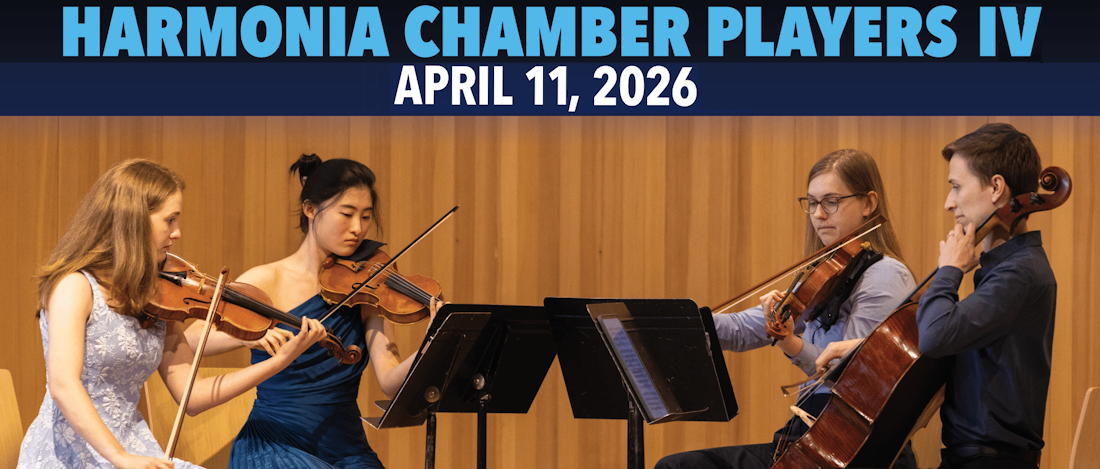
Saturday, April 11, 2026 • 2:00 p.m.
The Unitarian Church at 6556 35th Avenue NE
- tickets will also be available at the door, beginning at 1:30 p.m.
Program
Franz Joseph Haydn (1732–1809)
String Quartet in F major, Op. 77, No. 2
Caroline Shaw (*1982)
Entr’acte
Franz Schubert (1797–1828)
Octet in F major, D. 803
About the Concert
The 2025–2026 Harmonia Chamber Players series concludes with Haydn’s final string quartet, a work by Caroline Shaw inspired by that very quartet, and Schubert’s monumental octet for strings and winds.
Program Notes
Franz Joseph Haydn
String Quartet in F major, Op. 77, No. 2
Haydn was born in Rohrau, Lower Austria, on March 31, 1732, and died in Vienna on May 31, 1809. He composed this
quartet during 1799.
Although he wrote 106 symphonies and 45 piano trios (in addition to 123 trios for viola, cello and baryton — an instrument played by his longtime employer, Prince Nikolaus I of Esterházy), Haydn’s 67.5 string quartets established the form that would serve as a model for composers over the next two centuries. While his early works for a quartet of two violins, viola and cello took the form of five-movement divertimentos popular in Vienna at the time, the quartets he began composing at Esterházy codified the structure of a sonata-allegro first movement, followed by a slow movement, minuet with trio, and rondo finale. These were generally composed and published in groups of six.
In 1799, he began yet another set of quartets at the behest of Joseph Franz Maximilian, seventh Prince of Lobkowitz (who would later become the dedicatee of a number of important works by Ludwig van Beethoven, including his Symphonies No. 3, 5 and 6). Haydn completed two of the proposed six quartets before turning to other projects (including his oratorio The Seasons). He would later struggle for three years to compose another, but managed only to finish the two central movements.
The main theme of the opening movement of Haydn’s final complete string quartet, his Op. 77, No. 2, “is an ample, lyrical melody,” writes Richard Wigmore, “which Haydn immediately repeats and varies in an enriched texture.” Although Haydn calls the second movement a “minuet,” the tempo is presto and it is much closer to a scherzo from one of Beethoven’s symphonies than it is to a graceful courtly dance. The central trio is hushed throughout, never rising above a pianissimo, and deviating as far as possible from the F-major key of the minuet to D♭ major.
The slow movement (in D major — another surprising choice of key) begins with a duet for violin and cello and “unfolds as an individual synthesis of rondo and variations” resulting in “a quiet, and sublime, apotheosis of Haydn’s many ‘walking’ andantes.” The finale returns to the home key of F major, challenging the listener to guess the time signature (eventually revealed to be 3/4).
Caroline Shaw
Entr’acte
Caroline Adelaide Shaw was born August 1, 1982, in Greenville, North Carolina. She composed this work for the Brentano Quartet, which premiered it at Princeton University on March 21, 2011.
Caroline Shaw is a triple-threat musician: a violinist who has performed with the American Contemporary Music Ensemble, a singer with the vocal ensemble Roomful of Teeth, and the youngest composer ever to win the Pulitzer Prize for Music (for her 2009–2012 work Partita for 8 Voices).
“Entr’acte was written in 2011,” she writes, “after hearing the Brentano Quartet play Haydn’s Op. 77, No. 2 — with their spare and soulful shift to the D♭-major trio in the minuet. It is structured like a minuet and trio, riffing on that Classical form but taking it a little further. I love the way some music (like the minuets of Op. 77) suddenly takes you to the other side of Alice’s looking glass, in a kind of absurd, subtle, technicolor transition.”
— Jeff Eldridge
Franz Schubert
Octet, D. 803
_Schubert was born January 31, 1797, in Vienna, where he died on November 19, 1828. He composed this work during February 1824, completing it on March 1 of that year. It received its first private performance soon thereafter, but the public premiere did not occur until April 16, 1827. The Octet then languished in obscurity until 1861, when violinist Josef Hellmesberger reintroduced it to Vienna.
Schubert wrote his Octet in 1824, the same year as the A-minor “Rosamunde” and D-minor “Death and the Maiden” string quartets. The Octet came about at the request of Count Ferdinand von Troyer, an officer in Archduke Rudolf’s household who played clarinet and asked for a work modeled on Beethoven’s popular Septet of 1800. Schubert perhaps believed that such a piece might bring him the popular acclaim that he felt he lacked.
The structure and key relationships of the Octet are closely modeled on Beethoven’s Septet, which in turn is similar in structure to Mozart’s String Trio K. 563. Schubert adds an extra violin to Beethoven’s ensemble. That the work has an opening Adagio (following Beethoven’s model down to the number of bars, 18) is unique in Schubert’s chamber music. Its second measure contains two rhythmic motives that not only dominate the introduction but pervade the entire work. The second motive is evident in the main theme of the ensuing Allegro as well as the second theme introduced by the clarinet.
The slow movement opens with a serene 12-bar melody introduced by the clarinet, then lovingly paired with the violin. Toward the end of the movement the serenity is broken by a solitary plucked sforzando low F on cello and bass, and the movement ends without regaining its previous optimism. There is no hint of melancholy, however, in the vigorous third movement, based on two peasant dances: the vigorous dotted-rhythm steps of the G’stampfter and the gentler Ländler in the trio section.
The fourth movement consists of a set of variations based on the theme of a duet in Schubert’s singspiel The Friends from Salamanca, composed nine years earlier. The fifth movement, a classically structured Minuet and Trio, is a respite of relative simplicity after the preceding variations, preparing us for the further complexities of the finale, whose grief-stricken Andante molto introduction again features the dotted-rhythm motive. But the composer thumbs his nose at fate and cavorts off in what promises to be a boisterous conclusion.
— Chris Darwin